The new terror alert system in full
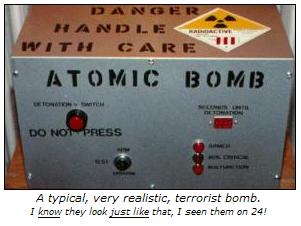 You may remember from last week that a new terror alerts system is to be introduced in response to the London bombing of 7th July. Clearly, it’s important that the public know the terror level at all times, because if we’d known that it was lowered from ‘severe’ to ‘substantial’ just before the attacks then we would’ve been more vigilant. Apparently. No, I don’t understand either.
Anyway, the new system does away with ‘Negligible’, because, durr, we’re always facing the biggest threat we’ve ever faced – otherwise we wouldn’t vote for policies which restrict our everyday lives (like ID cards or House Arrest). They’ve also combined ‘Severe Defined’ and ‘Severe General’ into ‘Severe’, because we can never be sure whether we’ve received intelligence about an attack anyway until after the attack takes place. And no-one really knows whether the intelligence is ‘patchy’ or ‘clear and authoritative’ anyway.
So how will the new system work? Well, I reckon the levels of threat will be determined much like this:
- Low: Oh my god, there’s a terrorist with a big nuclear bomb sat with a detonator in the centre of London. Best not panic the public, let’s keep the alert level down.
- Moderate: Hmm, some planes seem to be heading off course and towards some tall public buildings. Probably not worth calming the public completely, they might not accept draconian control measures, but let’s reassure them a bit.
- Substantial: The Daily Mail, that most reliable intelligence source, says someone who once passed Prince Charles’s butler’s cousin twice removed on Oxford Street made a comment that the Monarchy should be abolished! Clearly a terrorist plotting to kill the Queen!
- Severe: Someone seen calmly walking into a tube station wearing a light denim jacket. Shoot!
- Critical: Save our good Christian souls, a Muslim family has moved into a quaint village in Middle England! We don’t want those people here! Deport them!
So there you go! In fact, the official definitions are worse:
- Low: “An attack is unlikely”
Which presumably means it’s not likely, but it is possible. See also ‘moderate’. - Moderate: “An attack is possible but not likely”
Which presumably means an attack is, erm, unlikely. See also ‘low’. - Substantial: “Strong possibility of an attack”
Presumably meaning an attack is quite likely. See also ‘severe’. - Severe: “An attack is highly likely”
Or, there is a strong possibility of an attack. See also ‘substantial’. - Critical: “An attack is expected imminently”
But we’re not going to tell you where or when. Bwwaaaahaahaaa!
I feel safer already!
This post was filed under: News and Comment, Politics.